
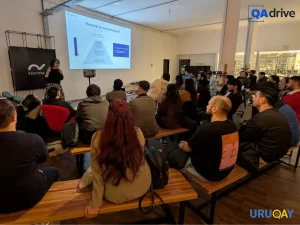
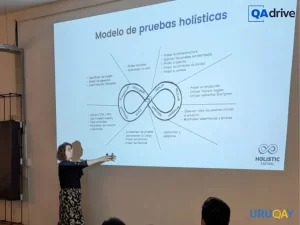
On June 12th, the second UruQAy meetup of the year took place at Roostrap’s offices in Montevideo, bringing the local testing community together to reflect on building quality in agile teams. During the meetup, Claudia Badell from our team facilitated the session Agile Testing Condensed: Key Ideas, based on the book by Janet Gregory and Lisa Crispin, which Claudia officially translated into Spanish.
The session invited attendees to reflect on how testing can evolve from a siloed tester’s task into a whole-team approach, focused on preventing defects, enabling fast feedback, and grounded in context-driven collaboration and shared responsibility.

Quality as a Shared Responsibility
One of the central themes of the session was the importance of treating testing as a shared responsibility across the entire team, rather than a task assigned solely to testers. Viewing quality not as a standalone outcome, but as something intentionally built in from the beginning, shifts testing from a final-phase activity to an integral part of the entire development and delivery cycle.
This approach requires revisiting not only testing practices but also how participation and decision-making occur within the team. To support this conversation, teams might ask:
- Who is involved in quality-related decisions, and at what stages?
- What structural barriers or cultural assumptions limit more active involvement?
- How visible is the state of quality and its associated risks to the team?
- What skills do we need to develop, individually and as a team, to ensure our test strategies integrate with development rather than act as separate activities?
Prevention Over Detection: A Mindset Shift
Another theme of the session was the shift from viewing testing as a defect-detection activity to embracing it as a preventive practice from the start. Rather than finding bugs at the end of the process, the goal is to anticipate risks and validate criteria through collaborative conversations from the earliest stages. This not only reduces the cost of fixing issues but also deepens the dialogue around what we are building and why.
Multi-Level Test Planning
A common barrier in agile teams is the disconnect between different levels of planning. In Agile Testing Condensed, Janet Gregory and Lisa Crispin emphasize the importance of addressing testing across multiple levels of detail: from individual tasks to stories, features, and release cycles. Clarity around what is being validated, how, and when not only aligns expectations but also supports better prioritization and more informed decision-making.
Without clear planning across these levels, teams often duplicate some validations while entirely omitting others, leading to misaligned efforts and overlooked risks.
This approach also encourages teams to plan more intentionally how they incorporate the testing skills needed across the team to support testing at the different levels.
Collaborative Strategies for a Stronger Quality Culture
The session also explored testing approaches and models that promote collaboration, including example-driven development, pair exploratory testing, the Agile Testing Quadrants, and the Test Automation Pyramid. These practices help teams align on quality criteria before writing code and incorporate diverse perspectives into product validation.
By adopting these practices, teams foster conversations that clarify assumptions, align expectations, and strengthen shared understanding. This kind of collaboration not only improves product quality but also nourishes a culture of continuous learning.
Change Starts with a Good Conversation
It’s not just about techniques, tools, or frameworks. Many of the changes that enable a more sustainable approach to quality begin with something simpler: a good conversation. Identifying assumptions, surfacing pain points, and aligning on success criteria as a team remains one of the most effective ways to foster a culture that genuinely values quality.
Bringing the Conversation on Quality Together
These ideas sparked a meaningful exchange during the UruQAy meetup, where participants raised questions, shared experiences, and explored diverse perspectives on how to apply these principles in real-world contexts. The audience’s active participation reflected a strong commitment to building a collaborative, quality-focused culture.
Frequently Asked Questions About Building Quality in Agile Teams
How does building quality differ from testing at the end of development?
How can agile teams build quality in from the start?
What role do conversations play in building quality in agile teams?
Why is prevention more effective than defect detection in agile teams?
Why is multi-level test planning important in agile teams?
What signals indicate that quality is not truly shared as a team responsibility?
Where Is Your Team Today in Terms of Quality?
An honest conversation is the best place to start. At QAdrive, we’ve developed an assessment that evaluates the maturity of your quality and testing practices across eight core areas.
We analyze how quality and testing are integrated into your development process and provide contextualized recommendations that support a whole-team approach to quality. Our insights help optimize testing within your CI/CD pipelines and guide the ongoing evolution of your testing practices in line with your business goals.